
A Leveraged Buyout (LBO) is one of the most iconic transactions in finance: acquiring a company through a combination of debt and equity. The purpose of this page is to walk through a complete LBO model — from base assumptions to IRR.
Starting Assumptions
These are the starting assumptions given (no calculations here):
- Revenues (LTM): 100 M$
- Annual Revenue Growth: 10% (constant for 5 years)
- EBITDA (LTM): 50 M$
- EBITDA Margin: constant
- D&A + Capex: 5% of annual revenues
- NWC: unchanged
- Tax Rate: 25%
- Entry Multiple: 10x EBITDA
- Exit Multiple: 10x EBITDA after 5 years
- Projection Period: 5 years
- Initial Leverage: 6x EBITDA
- Debt Interest Rate: 8%
- No capital amortization until maturity
TEV & Capital Structure
Now we start calculating the purchase TEV and the initial capital structure (Debt & Equity).
- EBITDA LTM = 50
- Entry Multiple = 10x
- TEV_in = 50 × 10 = 500
- Initial Leverage = 6 × EBITDA ⇒ Debt = 6 × 50 = 300
- Equity = 500 − 300 = 200
Result: TEV_in = 500; Initial Debt = 300 (60%); Equity Sponsor = 200 (40%).
Interest Expense on Debt
Debt is not amortized during the 5-year period, so interest is flat each year.
- Total Debt = 300
- Interest Rate = 8%
- Annual Interest Expense = 300 × 8% = 24
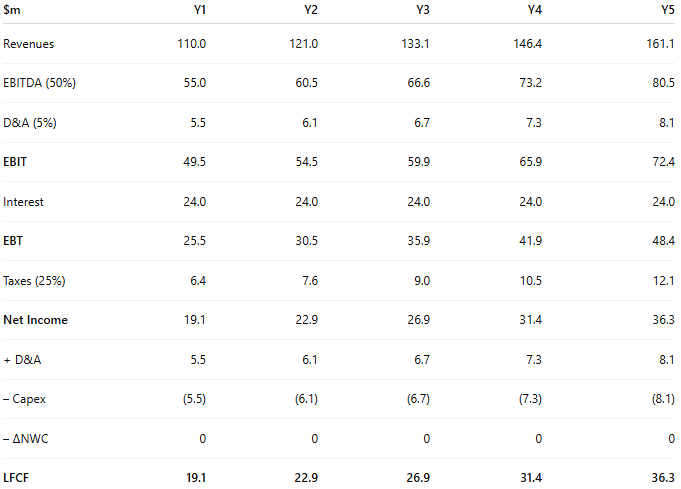
Projection over 5 Years
We project P&L down to (levered) free cash flow over five years.
Exit TEV & Returns
Step 1 — Exit TEV
- EBITDA Y5 = 80.5
- Exit Multiple = 10x
- TEV_out = 80.5 × 10 = 805
Step 2 — Exit Equity Value
- TEV_out = 805
- Net Debt = 300
- Equity Exit Value = 805 − 300 = 505
Step 3 — Returns
- Invested Equity = 200
- Exit Equity = 505
- MoM = 505 / 200 = 2.53x
I estimated the IRR by intuition: ~20% for ~2.5x in 5 years (rule-of-thumb: 2x in 5y ≈ 15%; 3x in 5y ≈ 25%).